Hi, |
Re: Traverse level 2 objects
In order to filter level 2 headings do something like the following:
outlining on;
level 1;

          Array level_1_headings = create(10,1)
          int index=0;


           Object o1 = null;
           for o1 in mod do {
                 println("\nObject Heading: " o1."Object Heading" "\t Object Text: " o1."Object Text" "")
                        put(level_1_headings, o1."Object Heading" "", 0, index++)
           } outlining off;
level 0;
|
Re: Traverse level 2 objects
So you have "Test Set" objects that have subordinate "Test Procedure" objects. You want to set "Test Set" summary attributes based on values of its "Test Procedure" objects. Sounds reasonable.
void MakeTestSetSummary(Object oTS)
{    // for the specified TestSet object, get info from its subordinate Test Procedures and set the summary attributes of the Test Set
   if (null oTS) then return
   if (oTS is not really a Test Set) then return
   iPassed = 0
   iFailed = 0
   iUnknown = 0
   for oTP in oTS do
   {  if (oTP is "passed") then iPassed++
      elseif(oTP is "Failed") then iFailed++
      else iUnknown++
   }
   set oTS attributes iPassed, iFailed, iUnknown
}  // MakeTestSetSummary()

//   MAIN
for o in entire mod do
{  if (isDeleted(o)) then continue
   if (o disqualifies for other reason's) then continue
   if (o is not a TestSet) then continue
   MakeTestSetSummary(o)
}
define MakeTestSetSummary() above; except using oTS.whatever = Results
if (obj is not a TestSet) //
then obj.attrDXLName = ""
else MakeTestSetSummary(obj)
|
Re: Traverse level 2 objects llandale - Thu Jun 07 13:08:59 EDT 2012
So you have "Test Set" objects that have subordinate "Test Procedure" objects. You want to set "Test Set" summary attributes based on values of its "Test Procedure" objects. Sounds reasonable.
void MakeTestSetSummary(Object oTS)
{    // for the specified TestSet object, get info from its subordinate Test Procedures and set the summary attributes of the Test Set
   if (null oTS) then return
   if (oTS is not really a Test Set) then return
   iPassed = 0
   iFailed = 0
   iUnknown = 0
   for oTP in oTS do
   {  if (oTP is "passed") then iPassed++
      elseif(oTP is "Failed") then iFailed++
      else iUnknown++
   }
   set oTS attributes iPassed, iFailed, iUnknown
}  // MakeTestSetSummary()

//   MAIN
for o in entire mod do
{  if (isDeleted(o)) then continue
   if (o disqualifies for other reason's) then continue
   if (o is not a TestSet) then continue
   MakeTestSetSummary(o)
}
define MakeTestSetSummary() above; except using oTS.whatever = Results
if (obj is not a TestSet) //
then obj.attrDXLName = ""
else MakeTestSetSummary(obj)
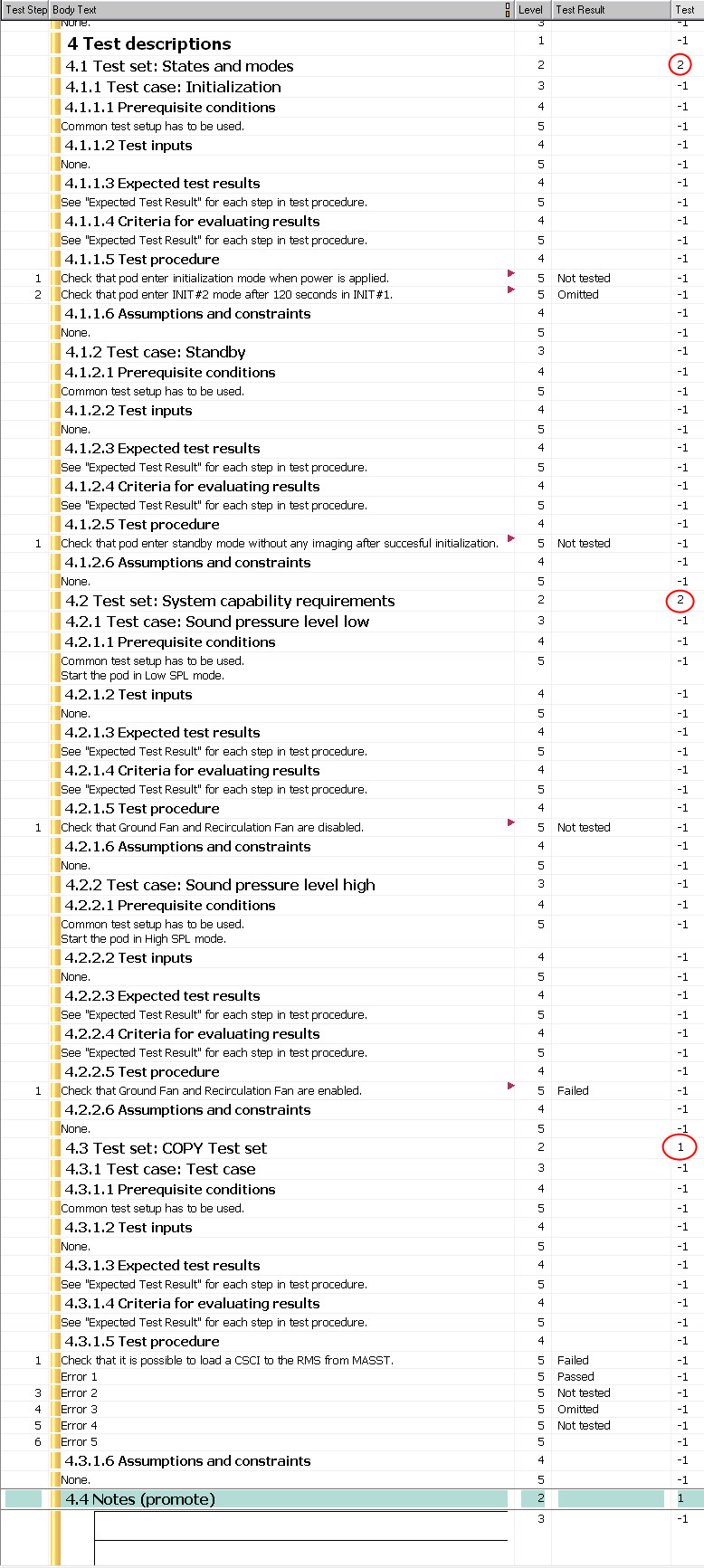
Thank you both very much for answering :-) I have tried the suggestion from Ilandale, but I can't make it work ;-( The suggestion is by the way very similar to my own attempt. I have tried to simplify the dxl script further in order to try to figure out whats going on. Object o = null Object oTP = null int iCount = 0 int MakeTestSetSummary(Object oTS) { if (null oTS) then return -88 iCount = 0 for oTP in oTS do { iCount++ } return iCount } // main if (level(obj) == 2) { obj.attrDXLName = MakeTestSetSummary(obj) } else { obj.attrDXLName = -1 } Ass it can be seen from the attached file, the output for heading 4.1 and heading 4.2 are both 2 and 1 for heading 4.3. It seems to me that the loop "for oTP in oTS do" runs only on level 3 headings (one level below selected level 2 from main)? I need the for-sentence to run on each object below, regardless of level. How do I do that? Thanks Klaus Attachments attachment_14833211_Output.jpg |
Re: Traverse level 2 objects KlausV - Fri Jun 08 08:43:53 EDT 2012 Yes the [for oChild in oParent do] loop only finds child objects directly under oParent; I see under 4.1 you have only 4.1.1 and 4.1.2; no 4.1.3; thus Test is "2". In order to get lower objects also you'll need some recursion.
int   CountTestProcedures(Object oParent)
{   // Count all the Test Summary objects under this Parent object, anywhere in its hierarchy
    // Function is RECURSIVE
    if (null oParent) return(0)
    Object oChild
    int Count = 0
    for oChild in oParent do
    {  if (oChild is a Test Procedure) then Count++
       Count += CountTestProcedures(oChild)   // RECURSION
    }
    return(Count)
}  // end recursive CountTestProcedures()

int MakeTestSetSummary(Object oTS)
{   if (null oTS or oTS is not a TestSummary) then return(-88)
    return(CountTestProcedures(oTS)
}
void CountTestProcedures(Object oParent, SomeDataStructure &Results)
{   // Accumulate Results of all the Test Summary objects under this Parent object, anywhere in its hierarchy
    // Function is RECURSIVE
    if (null oParent) return(0)
    Object oChild
    for oChild in oParent do
    {  if (oChild is a Test Procedure) then Add some info of oChild to Results
       CountTestProcedures(oChild)   // RECURSION
    }
}  // end recursive CountTestProcedures()

int MakeTestSetSummary(Object oTS)
{   if (null oTS or oTS is not a TestSummary) then return(-1)
    return(CountTestProcedures(oTS)
}
|
Re: Traverse level 2 objects llandale - Fri Jun 08 15:29:34 EDT 2012 Yes the [for oChild in oParent do] loop only finds child objects directly under oParent; I see under 4.1 you have only 4.1.1 and 4.1.2; no 4.1.3; thus Test is "2". In order to get lower objects also you'll need some recursion.
int   CountTestProcedures(Object oParent)
{   // Count all the Test Summary objects under this Parent object, anywhere in its hierarchy
    // Function is RECURSIVE
    if (null oParent) return(0)
    Object oChild
    int Count = 0
    for oChild in oParent do
    {  if (oChild is a Test Procedure) then Count++
       Count += CountTestProcedures(oChild)   // RECURSION
    }
    return(Count)
}  // end recursive CountTestProcedures()

int MakeTestSetSummary(Object oTS)
{   if (null oTS or oTS is not a TestSummary) then return(-88)
    return(CountTestProcedures(oTS)
}
void CountTestProcedures(Object oParent, SomeDataStructure &Results)
{   // Accumulate Results of all the Test Summary objects under this Parent object, anywhere in its hierarchy
    // Function is RECURSIVE
    if (null oParent) return(0)
    Object oChild
    for oChild in oParent do
    {  if (oChild is a Test Procedure) then Add some info of oChild to Results
       CountTestProcedures(oChild)   // RECURSION
    }
}  // end recursive CountTestProcedures()

int MakeTestSetSummary(Object oTS)
{   if (null oTS or oTS is not a TestSummary) then return(-1)
    return(CountTestProcedures(oTS)
}
Again, thank you very much for quick reply, and your solution did help me :-) My final dxl code ended up looking like this. /////////////////////////// constant declarations /////////////////////// const string attrName = "Result" // attribute to test const string attrVal = "Failed" // attribute value to test ////////////////////////// variable declarations ///////////////////////// int iCount = 0 string attr = "" Object oChild void MakeTestSetSummary(Object oHead) { if (null oHead) then return -88 for oChild in oHead do { if (probeAttr_(oChild, attrName ) != "") { attr = oChild.attrName } else { attr = "" } if (attr == attrVal) { iCount++ } MakeTestSetSummary(oChild) // traverse all childs recursively } } if (level(obj) == 2) { MakeTestSetSummary(obj) obj.attrDXLName = iCount } else { obj.attrDXLName = "" } |